Sabtu, 28 April 2018

Domain and range of a functionFunctions and their graphsAlgebra IIKhan Academy

Domain and range
Let's do some example problems
dealing with functions and their domains and ranges. Just as a review, a function
is just an operator-- let's say this function is f; that
tends to be the most typical letter for functions-- that
operates on some input, in this case, the input is x, and
it produces some output y. Or you could view it as you take
some input x, put it into your function box f, and it's
going to operate on it and produce some y. And the set of values that x
can take on is the domain.

The set of values that f can
legitimately operate on, that's the domain. And the set of values
y that f can produce, that is the range. Now, with that in mind, let's
figure out, one, the function definitions for each of these
problems here, these example problems, and then figure out
the domains and the ranges. So here we have Dustin charges
$10.00 Per hour-- so let me write that down-- $10.00 Per
hour for mowing lawns.

So how much does he charge
as a function of hours? So let's say Dustin charges, so
the function, I'll call it d for Dustin. Dustin charges as a
function of hours. It depends on hours. The input into our box
is going to be hours that he worked.

It's going to be equal to the
number of hours times 10. It's going to be 10 times-- I
won't write the times there. Maybe I can just write 10h. And, of course, he can't work
negative hours, so we could write h is going to be greater
than or equal to 0.

That's our function
definition. If you say, hey, how much is he
going to charge for working half an hour? You put 1/2 in here, which
essentially substitutes this h with a 1/2. You do 10 times 1/2. Let me write that down
on the side here.

So Dustin's going to charge
for 1/2 hour. He's going to charge 10--
wherever you see the h, replace it with 1/2-- times 1/2,
which is equal to $5.00. That's our function
definition. I was just showing you an
example of applying it.

Now, let's figure out the
domain and the range. So I almost explicitly say
it here, you can't work negative hours. This number, this function,
is not defined if h is less than 0. So we could say non-negative.

And we could say real numbers,
which it could be everything including pi and e
and all of that. But you can't legitimately
charge someone 10 times pi dollars. That's not a legitimate amount
that one can charge someone in the real world, because at the
end of the day, you have to round to the penny. You can't actually
charge them that.

So any number that he
charges is going to be a rational number. It can be expressed
as a fraction. So we can kind of take out
numbers like e and pi. So if we want to be really cute
about it, we would say non-negative.

Rational numbers. And these are just numbers that
can be expressed as a fraction, which are most
numbers, just not these numbers that just keep not
repeating and all of that. So non-negative rational
numbers is what he can input in here. And then the range, which is
the valid-- once again, whatever number you put in for
h, remember, you can only put in non-negative values for h,
non-negative rational values for h, so whatever numbers you
put in for h, you're going to get positive values for how much
he charges for 10h, for the value of the function.

So once again it's going to be
non-negative, and if you put a rational number here and it's
being expressed as a fraction and you multiply it by 10,
it's still going to be a rational number. And if you want to be really
cute, you could say any number that could be expressed
as a dollar sign. But anyway, I don't want to get
too cute on this problem. I think you get the idea.

Let's do more problems. All right. Here we have Maria doing
some tutoring. Maria charges $25.00 Per hour
for tutoring math with a minimum charge of $15.00.

So Maria charges as a
function of hours. So she's going to charge
$15.00 If you don't get enough hours in. So at $25.00 Per hour, in order
to make $15.00, You've got to work 15/25, so
it's 3/5 of an hour. So if her hours are less than
3/5 and greater than or equal to 0, she's going to
charge $15.00.

Because if she only worked 1/5
of an hour, the bill would have been $5.00, But
she says she has a minimum charge of $15.00. So she's going to charge $15.00
Up until 3/5 of an hour, or 36 minutes. And then after that, for h
greater than 3/5, she's going to charge $25.00 An hour. She's going to charge
25 times h.

So that's her function
definition right there. Now, what is the domain,
the domain for Maria's billing function? Well, once again, this
is only defined for non-negative numbers. And by the same logic we used
here, we got a little cute. We said, oh, she really can't
charge e hours or pi hours.

That's not realistic
for her to measure. Everything's going to be
expressible as a fraction. For example, even 5,
if you say 5 hours, that's still a fraction. That's 5 over 1.

So let's say non-negative
rational numbers. And what's the range of her
charging function or her billing function? Well, it has to be
at least $15.00. No matter what, she's going to
charge $15.00, So it's going to be $15.00 Or more. So it's going to be rational
numbers greater than or equal to $15.00.

There's no situation in which
she will charge $14.00. There's no situation
in which she would charge negative $1.00. Everything's going to be greater
than or equal to 15. So now we have these more
abstract function definitions, so now can stick really
any number in it.

Well, we're not going
to deal with complexes, any real number. But let's see if they limit
it a little bit. So we have f of x. Let me rewrite it.

F of x is
equal to 15x minus 12. So what's the domain here? What's our domain? Well, I can stick any real
number x in here and I'm just going to multiply it by 15
and then subtract 12. I could put pi there. I could put the square
of 2 there.

I could put e there. I could do all sorts
of crazy things. So I'm going to say
all real numbers. Any real number I put in for
x, I'm going to get a legitimate output.

And then what is my range? Well, once again, this can take
on any value out there. I can get to any negative
value if I. Make x negative enough. I'm going to subtract 12 from
it, but I could get to any negative value.

I could get to zero. I could get to any
positive value. So this is also going to
be all real numbers. Now we have this function.

It says f of x is equal to--
they forgot the equal sign-- 2x squared plus 5. So what is the domain? What are all of the valid values
for x that I could stick here? Well, I could stick
anything here. I could put e there. 2 Times e squared plus 5.

I could put a square
root of 2 there. I could put a negative
number there. So I could really take
on any real number. All real numbers, positive or
negative or otherwise, or even non-rational.

And then what is
the range here? And this is interesting. Because no matter what number
I put here, this value right here is going to be
greater than zero. This is going to be, right
here, non-negative. Even if you put a really
negative number here, you're going to square it, so it's
going to become a really positive number when
you square it.

So this expression right here
is going to be non-negative. So if you take a non-negative
number and you add it to 5, you're always going to get
something greater than or equal to 5. Worst case, this is a zero,
and then you get a 5. But if this is either slightly
less than zero or slightly more than zero, you're going to
get values greater than 5.

So the range is all real
numbers greater than or equal to 5. Your f of x could never take
on the value zero. There's no way to get zero. Problem 5.

They have f of x is
equal to 1 over x. So, once again, our domain. Well, we could put any
value in for x. Any real number will
work here.

We're just going to take
the inverse of it. So this is going to be all
reals, all real numbers. And then what is the range? This is interesting as well. Because no matter what I put
here, I can put anything here.

Oh, actually, let me be
very, very careful. This is not defined for
x is equal to 0. All real that are not
equal to zero. If I put zero here, I'm
going to get 1/0.

It will be undefined. Let me write that down. I almost made a mistake.
F of 0 is undefined. And that literally means
we don't know what to do with the zero.

We have not defined a way
to operate on a zero. So f of 0 is undefined. So the domain is all reals
except for zero. And now what's the range? Well, once again, we can take on
any value here except zero.

We could try to approach zero. If x got really, really, really,
really, really large, then this will approach zero. If x got really, really
negative, it'll approach zero. But in no circumstance will we
actually ever get to zero.

So once again, all reals that
are not equal to zero. All real numbers except
for zero. All right. Problem 6.

What is the range of the
function y is equal to x squared minus 5 when the
domain is-- so they're defining the domain. They're restricting it. They're saying the domain is
just the numbers minus 2, minus 1, 0, 1, and 2. So this function definition
really should say f of x is equal to x squared minus 5 for x
is equal to-- we could write any member for x is a member
of the set minus 2, minus 1, 0, 1, 2.

It's not defined for x being
anything else to that. You don't know what
to do with it. You can only apply it if
x is one of these. So what's the range? Well, the range is all of the
functions, all the values that f of x can take on.

So the range is going to be the
set of values that we get when we put in all of
these different x's. So let's try this first
one: negative 2. Negative 2 squared minus 5. That's 4 minus 5.

That's negative 1. Let's do negative 1. Negative 1 squared minus 5. That is 1 minus 5.

That is negative 4. You have 0. 0 Squared. So f of 0, you have 0 squared
minus 5, that's negative 5.

And you have 1. 1 Squared minus 5, that's
negative 4, so it's already in our range. Then you have 2. 2 Squared minus 5, that's
negative 1, already in our range.

So that's all of the values that
this function can take on, given that we've
restricted it to only these inputs..

Jumat, 27 April 2018

Domain and range of a function given a formulaAlgebra IIKhan Academy

Domain and range
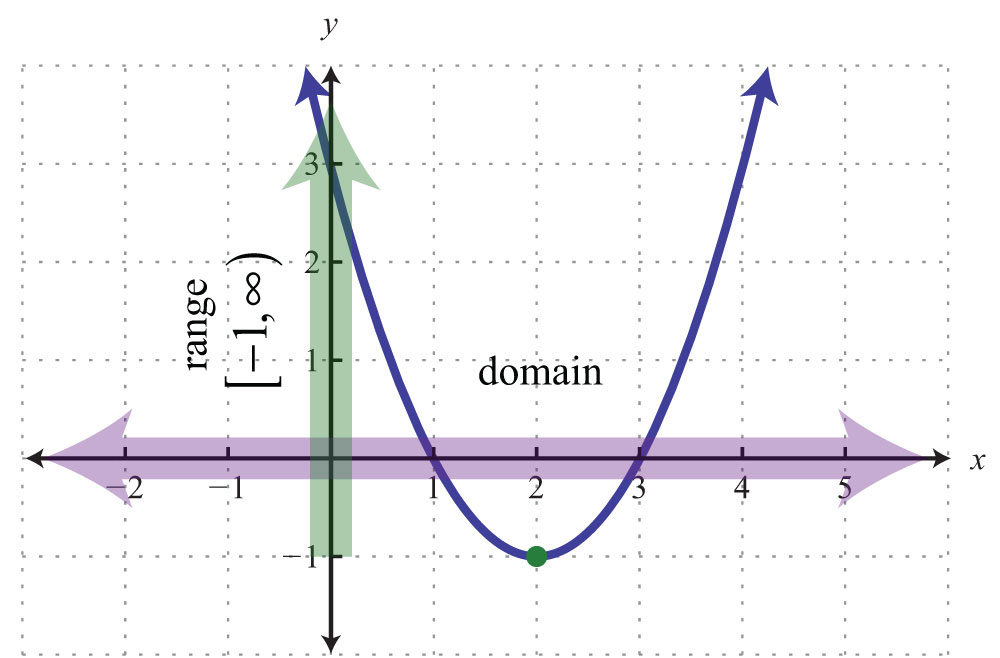
Determine the domain and range of the function f of x is equal to
3x squared plus 6x minus 2. So, the domain of the function is:
what is a set of all of the valid inputs, or all of the valid x values
for this function? And, I can take any real number,
square it, multiply it by 3, then add 6 times that real number
and then subtract 2 from it. So essentially any number if we're talking
about reals when we talk about any number. So, the domain, the set
of valid inputs, the set of inputs over which this function
is defined, is all real numbers.

So, the domain here is
all real numbers. And, for those of you who might say, well,
you know, aren't all numbers real? You may or may not know that
there is a class of numbers, that are a little bit bizarre
when you first learn them, called imaginary numbers
and complex numbers. But, I won't go into that right now. But, most of the traditional
numbers that you know of, they are part of
the set of real numbers.

It's pretty much
everything but complex numbers. So, you take any real number
and you put it here, you can square it, multiply it by 3,
then add 6 times it and subtract 2. Now, the range, at least the way we've
been thinking about it in this series of videos-- The range is set of possible,
outputs of this function. Or if we said y equals f of x
on a graph, it's a set of all the possible y values.

And, to get a flavor for this,
I'm going to try to graph this function right over here. And, if you're familiar with quadratics-- and that's what this function is
right over here, it is a quadratic-- you might already know
that it has a parabolic shape. And, so its shape might look
something like this. And, actually this one will
look like this, it's upward opening.

But other parabolas
have shapes like that. And, you see when a parabola
has a shape like this, it won't take on any values
below its vertex when it's upward opening, and it won't take on any values above
its vertex when it is downward opening. So, let's see if we can graph
this and maybe get a sense of its vertex. There are ways
to calculate the vertex exactly, but let's see how we can
think about this problem.

So, I'm gonna try some x and y values. There's other ways to directly compute the
vertex. Negative b over 2a is the formula for it. It comes straight out of the quadratic formula, which you get from completing the
square.

Lets try some x values and lets see what f
of x is equal to. So, let's try, well this the values we've
been trying the last two videos. What happens when x is equal to negative
two? Then f of x is 3 times negative 2 squared,
which is 4, plus 6 times negative 2, which is 6 times negative 2,
so it's minus 12 minus 2. So, this is 12 minus 12 minus 2.

So, it's equal to negative 2. Now, what happens when x is equal to
negative 1? So, this is going to be 3 times negative 1
squared, which is just 1, minus, or I. Should say plus 6 times negative 1 which
is minus 6 and then minus 2, and then minus
2. So, this is 3 minus 6 is negative 3 minus 2 is equal negative 5, and that actually
is the vertex.

And, you know the formula for the vertex,
once again, is negative b over 2 a. So, negative b. That's the coefficient on this term right
over here. It's negative 6 over 2 times this one
right over here, 2 times 3.

2 Times 3, this is equal to negative 1. So, that is the vertex, but let's just
keep on going right over here. So, what happens when x is equal to 0? These first two terms are 0, you're just
left with a negative 2. When x is equal to positive 1.

And, this is where you can see that this is the vertex, and you start seeing the
symmetry. If you go one above the vertex, f of x is
equal to negative 2. If you go one x value below the vertex, or
below the x value of the vertex, f of x is equal to
negative 2 again. But, let's just keep going.

We could try, let's do one more point over
here. So, we have, we could try, x is equal to
1. When x is equal to 1, you have 3 times one
squared which is 1. So, 3 times 1 plus 6 times 1, which is
just 6, minus 2.

So, this is 9 minus 2 it's equal to 7. And, that I think is enough points to give us a scaffold of what this graph will look
like. What the graph of the function would look
like. So, it would look something like this.

I do my best to draw it. So, this is a x equals negative 2. We draw the whole axis. This is x is equal to negative 1, this is
x is equal to, this is x is equal to 0 and then this is x is equal to
1 right over there and then when x is equal to, we go from negative 2
all the way to positive.

Or, we should go from negative 5 all the
way to positive 7. So, let's say this is negative 1,2,3,4,5. That's negative five over there on the y
axis, y axis and then it will go to positive 7. One, two, three, four, five, six, seven.

I could keep going, this is in the y, and
we're going to set y equal to whatever our output of
the function is. Y is equal to f of x. And this is one right here. So, lets plot the points.

You have the point negative 2, negative 2. When x is negative 2, this is the x axis. When x is negative 2, y is negative 2. Y is negative 2 so that is that right over
3.

So, that is the point, that is the point
negative 2, negative 2. Fair enough? Then, we have this point that we have this
pink or purplish color. Negative, when x is negative 1, f of x is
negative 5. When x is negative 1, f of x is negative
5.

And, we already said that this is the
vertex. And, you'll see the symmetry around it in
a second. So, this is the point negative 1, negative
5. And then, with the point 0, negative 2.

0, Negative when x is a 0, y is negative
2, for f' of x is negative 2 or f of 0 is negative 2, so this is the
point 0, negative 2, and then finally when x is equal to 1 and
f of 1 is 7, f of 1 is 7. So, that's right there it's a point 1, 7
and it gives us a scaffold for what this parabola, what this
curve will look like. So, I'll try my best to draw it
respectably. So, it would look something, something
like that, and keep on going in that direction.

Keep on going in that direction. But, I think you see the symmetry around
the vertex. That if you were to. If you were to put a line right over here,
the two sides are kind of the mirror images of
each other.

There, you can flip them over, and that's
how we know it's the vertex. And, that's how we also know, because this
is an upward opening parabola, I. Mean, there is formulas for vertex, and
there are multiple ways of calculating it. But, since it's an upward opening
parabola, where the vertex is going to be, the minimum
point.

This is the minimum value that the
parabola will take on. So, going back to the original question,
this is all for trying to figure out the range, the set of y values, the set of
outputs that this function can generate. You see that the function, it can get as
low as negative 5. It got all the way down to negative 5
right at the vertex.

But, as you go to the right, as x values
increase to the right or decrease to the left, then
the parabola goes upwards. So, the parabola can never give you
values-- f of x is never going to be less than
negative 5. So, our domain,
but it can take on all the vaues. It can keep on increasing forever as x
gets larger, x gets smaller farther away from
the vertex.

So, our range, so we already said our
domain is all real numbers. Our range, the possible y values
is all real numbers greater than or equal to negative
5. It can take on the value of any real number greater than or equal to
negative 5. Nothing less than negative 5..

DNS Explained

DNS Explained
Today, there are people trying to dictate how the Domain Name System-known as DNS by the cool kids, and by association, the Internet as a whole, works. Unfortunately, many of these powerful individuals, and others, dont understand what exactly DNS is. This video is for them and for anyone else that wants to learn about DNS. We are going to go over the basics of what DNS is, how it works, and how if you use the Internet, it affects your life daily.

Think you know what DNS is already? Stick around anyway, you might learn something. Here at DNS Made Easy we love DNS and could obviously spend hours going into each and every detail, but were only explaining the basics here. If you ever decide to run for public office someday and want to make decisions on DNS  This will help. OK lets begin.

The Domain Name System is indisputably one of the most important and over-looked parts of the Internet. Without DNS, the Internet as we know it today, would collapse, and we would all be licking stamps to pay our bills, driving to an actual store to purchase something, reading the newspaper to see what movies were showing, or buying little round pieces of plastic called CDs to get our music.                        How can we say that DNS is this important? We all know (or should know), that the computers that make up the Internet are set up in large networks that communicate with eachother via underground (or under water), wires and are identified using strings of numbers known as IP addresses.  Since the majority of us lack the mental capacity to sort through and retain hundreds of numerical series, DNS is used to translate an actual name into these numbers.

But how does the Domain Name System work?   In a web browser lets say you enter the URL, www.Example.Com as a well, as an example. When you type www.Example.Com into your address bar, you will actually be looking for www.Example.Com.. Yes there is a dot at the end of the domain name. One that you never see.

And one that you never type. When you type in www.Google.Com, you are actually going to the page www.Google.Com.. Seriously. Try it out, well wait.

(Crickets chirp)  Ok look, that's long enough Anyway that end dot represents the root of the Internets name space.The Root!  Why is this so important? Because this is where it all begins. When you first search for www.Example.Com., Your browser and your operating system will first determine if they know what the IP address is already. It could be configured on your computer or it could be in memory, what the cool kids call cache.  No, not cash as in cash money; the memory cache, C-A-C-H-E.

Keep up, will ya?! Anyway... So the browser asks the operating system and they both dont know where www.Example.Com. Is. What happens next? The operating system is configured to ask a resolving name server, for IP addresses is does not know.

This resolving name server is the workhorse of the DNS lookup. It is either configured manually or automatically within your operating system. Your operating system asks (or queries), the resolving name server for www.Example.Com.. The resolving name server may or may not have this in memory or, you know, cache.

Yes the C-A-C-H-E one, not the... Nevermind. For the sake of this demonstration, it does not. The only thing that all resolving name servers should know, is where to find the root name servers.

Yes, that enigmatic dot that appears at the end of every domain name you type into that address bar. The root name servers will reply with I dont know, But I do know where to find the com name servers. Try there.  The COM name servers are called the Top Level Domain name servers or TLD name servers.

The resolving name server then takes all of this information from the root name servers, puts it in its cache, and then goes directly to the COM TLD name servers. When the resolving name server queries www.Example.Com, the TLD name servers respond, I dont know, but I do know where to find the Example.Com name servers. Try there.   This next set of name servers are the authoritative name servers.

So how did the COM TLD name servers know which authoritative name servers to use? With the help of the domains registrar. When a domain is purchased, the registrar is told which authoritative name servers that domain should use.  They notify the organization responsible for the top level domain (the registry), and tell them to update the TLD name servers. So anyway  The resolving name server takes the response from the TLD name server, stores it in cache, and then queries the example.Com name servers.

At this point, the authoritative name server will say, Hey! I know where that is!  Tell your browser to go to the IP Address 192.168.1.1!   The resolving name server takes this information from the authoritative name server, puts it in cache, and gives the reply to the operating system.  The operating system then gives this to the browser and the browser then makes a connection to the IP address requesting the web page for www.Example.Com. Pretty cool huh? While the process seems complex-and, believe me it is, this whole cycle take less time than it takes you to blink an eye.  DNS was designed to work extremely fast and efficiently.

It is an integral part of the Internet. Once you understand this, you can clearly see the many different facets and organizations that are responsible for a single DNS lookup.  One lookup! There is a resolving name server, the root name server, the TLD name servers, and the authoritative name servers. If anyone were to dramatically change or filter any part of the DNS process, it could lead to disaster.

This is why we believe the people with the power to pass legislation need to understand whats at stake before making decisions that could drastically affect how the Internet works! If you want to learn more about DNS, and see the DNS process in action first hand, type www.Dnsmadeeasy.Com into your browser. Brought you by DNS Made Easy; providing enterprise authoritative DNS for over 10 years. If DNS Made Easy isnt already managing your domain, contact us to see how we can lower your costs, increase your uptime, and increase your speeds..

Kamis, 26 April 2018

What Is The Difference Between A Domain Name And A WebsiteGoDaddy

What Is The
Hi there. In this video, you'll learn the difference between a domain and a website. While domains and websites are closely connected, they are two very different things. After registering a domain, you need to do something with it, put it to work for you.

Your domain can be used for a website, for an email account, or for both. You can, however, register a domain and choose NOT to use it for a website or an email account, BUT you can't have a website or an email account without a domain. When used for a website, your domain name is what people type into their browser to find your site  this is why they are sometimes referred to as web addresses. So godaddy.Com is the domain used for GoDaddy's website.

Registering a domain, however, doesn't automatically create a website  it only means that you've registered the domain. So for example, if you decided to start your own business and you thought of great name for it, you might copyright the name to protect it. However, simply giving your business a name is only one of many steps that go into building your business. In the same manner, when you register a domain and want to use it for a website, you'll need to first build the website, and then find a host for it, so it can be visible on the Web.

What's a host? Website hosts are companies that house, serve, and maintain files for one or more websites. Think of a website hosting company like a shopping center that contains several individual stores. If you want to open a store at the shopping center, you can lease space and set up shop. Just like a shopping center, website hosting companies enable you to lease space on their web servers, where you can store your website files and make them available for visitors to view.

Because you've registered your domain, you can use it at any web hosting company you want. Remember your store in the shopping center? Suppose you decided to move your store and lease space at a different shopping center. If you packed up your products and moved to a new location, you would still be able to use the same name for your store. The same is true for your domain  regardless of where you decided to host your website's files, your domain remains yours for the duration of your registration.

GoDaddy is both a domain registrar AND a website hosting company  and we have the tools to help you build your website. This means you can register your domain name, build a website for it, and get it on the web  all in one place! Do you already have a domain name? Don't just let it sit there; do something with it!.

What is a Domain Name How to register a Domain Name Domain Name kya hai, kaise register kare

What is a
What is a domain name ? How to register a domain name ? In this video we shall learn about domain names. What is a domain name ? How many kinds of domain names are there? How to choose a good domain name ? How to register a domain name ? Hello. My name is Aekta. What is a domain name ? A domain name helps us reach an IP address.

If I say Rashtrapati Bhawan , you will understand that  I mean Prakash Vir Shastri Avenue New Delhi. If I give you an IP address , you may possibly not remember it . If I tell you my domain name - KyaKaise.Com , you will be easily able to reach my web address. A domain name helps you to reach a website without knowing the IP address.

How many kinds of domain names are there? The main top level domain names are .Com for companies, .Net fot network , .Org for organizations .Edu for schools or colleges & .Gov for government websites. In India you will also find domain names ending in .Co.In & .In as well. It is important that you choose a good domain name for your website. Choose a domain name that is short & easy to remember Which has some originality & is easy to spell.

Let's see how to register a domain name . There are a no. Of websites where you can register a domain name. In this video I will tell you about Go Daddy.

There is a link in the description of this video below. Click on this to go to Go Daddy. The Go Daddy site is open . If you are coming here for the first time you will need to register & create a new account here.

Once you have completed the registration or if you are returning to the site you can click on Sign In. Click on Register to open a new account. Click on Create My Account . Fill the various fields.

Enter the email address & choose the username. Choose a password. It is telling us that the password should be 9 characters long and must contain an upper case letter & no. Let's choose a new password.

Now you need to choose a 4 digit call in PIN. If you need to call customer service for any issues you will need to give them the 4 digit PIN. It is asking you not to choose a sequential PIN such as 1234 or 1111. Choose a PIN which is easy for you to remember but difficult for others to guess.

Let's choose a PIN. Choose a PIN & click on Create Account. Now I am inside the Go Daddy site. There is an alert & it is asking me to update my profile in 30 secs.

Choose I own a business or non-profit for what best describes you & click Next. Choose Educational Services for  the question "Which best describes your business". Let's quickly finish this 4-5 question survey I have completed the short survey . I am logged in the Go Daddy site.

Click on the + icon. It is informing us that we don't have any domains. Click on the link which says Get One Now. You are directed to a new page.

You can search for the availability of a domain name here. You can check if the domain name that you want is available or not. Let's enter KYAKAISE.COM & click Search Domain I have already registered this domain name so it is not available. If someone else tries to register this domain name they will get this message.

However a no. Of alternate options are given below. Such as kyakaise.Guru, kyakaiseonline.Com, kyakaisenow.Com, kyakaisegroup.Com etc. However the intention is not to copy Kya Kaise.

We want to create a completely new domain name. Let's search for a new domain name - Type Video.Com in the search bar & click Search again. Video.Com is not available. Let's search for videoclass.Com & click search again.

Even videoclass.Com is not available. I am trying to create a new website where I will teach about videos. Let's type VIDEOKAISE.COM & click Search Again. This domain name is available.

It is telling us that normally this domain name costs Rs959 but if you register for 2 years or more the first year price is only Rs.189. Since there is a sale going on you can get this domain name cheaper. Click on Continue to Cart. This domain name has been added to our cart.

You have a few options here . In the first step you can protect your personal information. If you purchase this , no one will be able to know who owns this domain name. There are a no.

Of bots on the internet who spam your email id. This privacy option can help protect against that. However this is optional & you can purchase it or you can choose to proceed by clicking No Thanks . I will purchase the privacy protection which costs approx.

Rs.500. Next you can purchase the website builder & hosting or you can purchase the hosting separately. However I don't need these . Next you can add an email address for your business.

The email address will be aekta@videokaise.Com Since I have chosen the domain name to be videokaise.Com it will combine my name with the domain name to create an email address. You can add your name to the domain name to create the new email address. It costs Rs.200 Per month to create the email address. I don't need it at this time so I will click on No Thanks Click on Continue to Cart.

Click on the shopping cart icon on top which says checkout now . We are in the shopping cart now. You can choose for what duration you want this domain name . You can choose to purchase the domain name for 1, 2 , 3 , 5 or 10 years .

For now I will choose 1 year only. It will cost me Rs. 589 For 1 year. You can keep your domain name private or public.

If you keep this public , your personal information will be visible on the domain name. I will keep this as private. It is asking me if I also want to purchase videokaise.Net, videokaise.Co or videokaise.Info. However I don't want to purchase any of these matching domain names.

Click on Remove since I don't want the Email id linked to the domain name . The cart is being updated. Click on Remove since I don't want to purchase the personal website builder. It is saying that you can list your site in Google , Yahoo & Bing.

This would cost approx. Rs.128 Per month. This would increase the traffic on your site. Let me leave this for now .

This is our domain name & this is the ICANN fee that we need to pay. ICANN is the company that registers all the domain names. The total cost is approx. Rs.900 Click on Proceed to Checkout.

You need to enter your biling information here. Enter you first name, last name , company name , Email Address, Country , Address & Zip Code. You can enter you phone no. Here as well.

You need to enter your payment information here. You can use your credit/debit or prepaid card here. You can pay via Visa or MasterCard. Enter the Card no.

& Security code. Enter the card holder name & expiry date of the card. Let's select Net banking here Click on Continue Our billing and payment information is displayed here. You can't see it since I have masked it .

It is summarising the order information and telling us that we are purchasing the domain name videokaise.Com for 1 year at a cost of Rs. 889.61 Click on Place Your Order to confirm the order. It is notifying us that our order has been submitted. The order details & account information is also displayed.

Go to domains & click on Manage My Domains The domain name VideoKaise.Com is displayed here & it will be with me for the next one year . I have successfully purchased this domain name for 1 year. Now you can also register a domain name for your business or tuition center A good domain name helps to give a professional image to your business. If you liked the video please press the Like button in You Tube & share the video.

Subscribe to our You Tube channel to get regular updates on new videos. Keep Watching Kya Kaise & Keep Learning . Thank You.

Connect Your Domain to a WordPress WebsiteGoDaddy

Connect Your Domain
You have a great looking WordPress website,
and now youve registered the perfect domain name. Ready to connect them? This video explains how to connect, or forward,
your custom domain name to your WordPress website. If you used WordPress to create a free website, your web address includes the name you chose thats appended with .WordPress.Com. But if youve registered a custom domain
name with GoDaddy, why not use it for your WordPress website? When you set up forwarding on your domain, visitors who search for your domain or enter it in a web browser, will see your WordPress site.

Lets see how In your web browser, navigate to your WordPress website. Next, click in the address bar of your web browser, highlight the URL for your WordPress site and copy it to your clipboard. Now log into your GoDaddy account. On the Products page, find Domains, and to the right of it, click Manage.

On the Domains page, choose the domain name that you want to forward to your WordPress website, and click Use My Domain. In the domain connector, click Connect to an Existing Site. On the Destinations screen, under Websites, click WordPress. Click in the WordPress blog URL field, and paste in the text you copied to your clipboard.

When youre finished, click Next. This dialog box is just asking you to confirm that you want your GoDaddy domain name to forward to your WordPress website. To confirm, click Finish. Thats it! Now when anyone types your unique domain name into a browser, theyll see your WordPress website.

Try it out!.

Top 3 Best Web Hosting for WordPress (2016)

Top 3 Best Web Hosting for WordPress (2016)
- [Narrator] Are you looking to create your first website or blog with WordPress? As the most powerful website
platform on the planet, WordPress has allowed
millions of ordinary people to create amazing websites
with zero coding required. If you're looking to get started, you'll need a Web Host in
order to install WordPress, and in this video, I'll
reveal the top three best web hosts for WordPress beginners. After hands-on testing and comparison, we've determined that these
three popular web hosts are perfect for beginners
looking to get started with WordPress in a matter of minutes. Stay tuned to find out more.

(Tinkling chimes) Hey, what's up guys? ODI productions here
from How2MakeWebsite.Com, your number one online resource for building your very
first website or blog. So today, we have a
special comparison video where we'll be recommending
our top three picks for the best web hosts
for WordPress beginners. For those new to WordPress or
unfamiliar with web hosting, we're going to briefly
explain what a web host does and why you need one. So by now, you probably
heard that WordPress is a powerful content-management system used by top bloggers
and big websites alike, such as TechCrunch.Com.

Here at How2MakeWebsite.Com,
we stand behind WordPress as the best blogging
platform in the world, and we're committed to empowering others to create their own websites
easily and affordably. So how do you get started? Well, before you needed three things to get a WordPress website up and running, and these three things
were, one, a domain name such as How2MakeWebsite.Com,
two, a web host which allows you to install WordPress and store your information
live on the internet by renting you space on their web servers, and three, a manual installation
of the WordPress platform, downloaded from WordPress.Org. Before, you had to get
all three of these things and connect them all together manually, which can be a headache for most people with no web developing experience. Today, when you sign up for any of these recommended web hosts, you get all three bundled
together with no hassle or fuss.

So which three web hosts
do we recommend, you ask. Before we rank them individually,
our top three include bluehost, HostGator, and SiteGround. With each of these web hosts, we were able to sign up and build a WordPress website from scratch in just minutes. At this moment, we would also like to give an honorable mention to DreamHost, which is another
WordPress-recommended web host.

Now we're going to compare performance by running a website site speed test to see who's the fastest on
the basic shared server plan. The way we conducted this
test is by using a tool by the company Pingdom, which
preforms a website speed test based on performance,
optimization, and load times. Each website used the exact
same theme, header image, and then one blog post
with a single image. Also, we added the same
caching plug-in to each website to max out performance.

Here are the results. As you can see here,
each host scored the same performance grade of an 88, which means that our
websites are highly optimized by using the same theme
and caching plug-in. Now the difference is in load times, especially when compared
to all other sites tested. Comping in third, the
HostGator site loaded up in 1.9 Seconds, which is faster
than 74% of tested sites.

That's pretty solid performance for a basic shared server plan. In second, we have bluehost which loaded significantly
faster than HostGator with a load time of just 1.11 Seconds. This load time was quick
enough to be considered faster than 88% of tested sites. What surprised me the most
was SiteGround's performance, since SiteGround is a much smaller company than the giants bluehost and HostGator.

The SiteGround site loaded
up in under a second, at a blazing 769 milliseconds, which is faster than a
whopping 93% of tested sites. And all of this on the most
basic, shared server plan. So for performance, SiteGround
blazes past the competition with bluehost coming in
second, and HostGator third. Now that we know the performance numbers, next we're going to compare pricing, both normal and on sale,
to see which web host is actually the most
expensive, whether on sale or during regular pricing.

All plans we are looking at will be the most basic shared server plan, which is more than enough for beginners and comes WordPress-ready. PS: If you want access to
these special discounts, click the link to the Resource Page in the description below. For HostGator, regular
pricing without discounts starts at $8.95 Per month, which is a little bit on the pricier side. After applying discounts,
the current sale plan pricing starts as low as $3.95
For a three year plan, and $5.95 For a one year plan.

So less than $6 a month is
very fair for what you get. One last note about HostGator
is they do not offer a free domain upon registration. So that adds an extra
$12.95 To your total costs. For bluehost, regular pricing
without discount starts at $7.99 Per month, about a
dollar cheaper than HostGator.

After applying discounts,
the current sale pricing matches up with HostGator,
starting at $3.95 For a three year plan, and
$5.95 For a one year plan. The difference is that bluehost
includes your domain name free of charge with your
sign-up, about a $12 value. For our best performer SiteGround, regular pricing without discount starts at $9.94 Per month, which
is the most expensive out of the three, but you also
get the fastest performance. After applying discounts,
the current sale pricing drops by a whopping 60%
to only $3.95 Per month, and this $3.95 Rate applies
to one year plans as well.

On top of all that, you
also get a free domain name, just like bluehost. After reviewing the
pricing and performance, it's clear to see that SiteGround starts to pull away from the
competition based on value. Once again, make sure to
visit the Resource Page below to access the lowest prices
and best discounts available, updated daily on our site. Now, it's time to finally
rank our top three web hosts individually, by discussing
the benefits of each while factoring in the performance scores and pricing we just went over.

So coming in at third place is HostGator, which came in last in performance but ended up with the
highest cost after discounts. It's important to remember
that the HostGator site still loaded faster than
74% of tested sites, which is not slow by any means. This may seem like a disappointing finish, but remember, we're looking
at the top three web hosts for WordPress overall, so
HostGator is still a better choice than the hundreds of web hosts out there. The benefits of HostGator include: award-winning tech support
and server reliability with a 99.9% Uptime guarantee.

This basically means that
over the course of one year, your website may only be down for less than nine hours
total out of that entire year. This is a major key for a lot of people and one of the reasons why HostGator is up here with the best. WordPress 1-click install, this is one of the most important features for WordPress beginners,
as it allows you to install the WordPress platform onto your domain just minutes after signing up. If you're a beginner, this
is a must-have feature as it saves you the headache of having to install WordPress yourself.

Best of all, HostGator
features a generous 45-day money-back guarantee, longer than either bluehost or SiteGround. If you think HostGator is
the right web host for you, make sure to watch our step-by-step video on how we created this exact website just minutes after
signing up with HostGator. Coming in at number two is
the ever-popular bluehost. Along with HostGator,
bluehost is one of the most recognizable household names
in the web hosting market.

Chances are that the popular blog you like runs on either of these web hosts. Bluehost continues to
grow year after year, and is a fan favorite for newbie bloggers. Here are some of the benefits for beginners looking to use bluehost. You'll receive your domain
name completely free of charge for the first year, unlike
HostGator who charges $12.95.

Bluehost is the #1 recommended web host by the official WordPress website. It's also the most popular
choice for WordPress users, powering over two million websites. It includes WordPress 1-click install, and you get a 30 day money-back guarantee. If you think bluehost is
the right web host for you, make sure to watch our step-by-step video on how we created this exact website just minutes after
signing up with bluehost.

In a surprise finish,
coming in at number one is the underdog, SiteGround. What's not to love about SiteGround? They are a much smaller company than either bluehost or HostGator, but they scored the
fastest performance scores and lowest pricing after discounts. No doubt, the value here is exceptional. Now, SiteGround may not be
as much of a household name as the other two, but it
is one of the most popular web hosts for WordPress
users specifically, and is also an official
recommended web host on the WordPress website,
as you can see here, so it's not like they're unknown.

In recent years, SiteGround
has rapidly gained a huge and loyal following through their top-notch customer service, not to mention fantastic
performance and reliability for the money. Here are some of the
benefits for beginners looking to use SiteGround. An official
WordPress-recommended web host. You get your domain name
completely free of charge when signing up, just like bluehost.

WordPress 1-click install, and a 30-day money-back guarantee. If you think our winner siteground is the right web host for you, make sure to watch our step-by-step video on how we created this exact website just minutes after signing
up with SiteGround. So that wraps up our top
three recommendations for WordPress web hosting for beginners. Honestly, you can't go wrong with either of these top three picks.

The more important thing
is to just get started. Be sure to check out any
of these three videos which shows you how to get started with the web host of your choice. Also, if you want to get access to our special discounted pricing, click the link in the description below which will take you to our Resource Page with all of our available
web hosting discounts. We update this every day, so be sure to check it out often.

Last but not least, if you
found this video useful, please leave a thumbs up and a comment, because it really helps
the channel to grow. Also, subscribe for
more WordPress tutorials and videos just like this. If you made it to the end, thank you for watching this video, and I hope you have a
wonderful and productive day. (Lighthearted music).